

Welcome to On the Line! A series from Hotline Skin, bringing you exclusive interviews with founders, formulators, strategists and other key players in beauty. I’ll ask the first round of questions and then turn it over to you. Missed one? Read them all here.
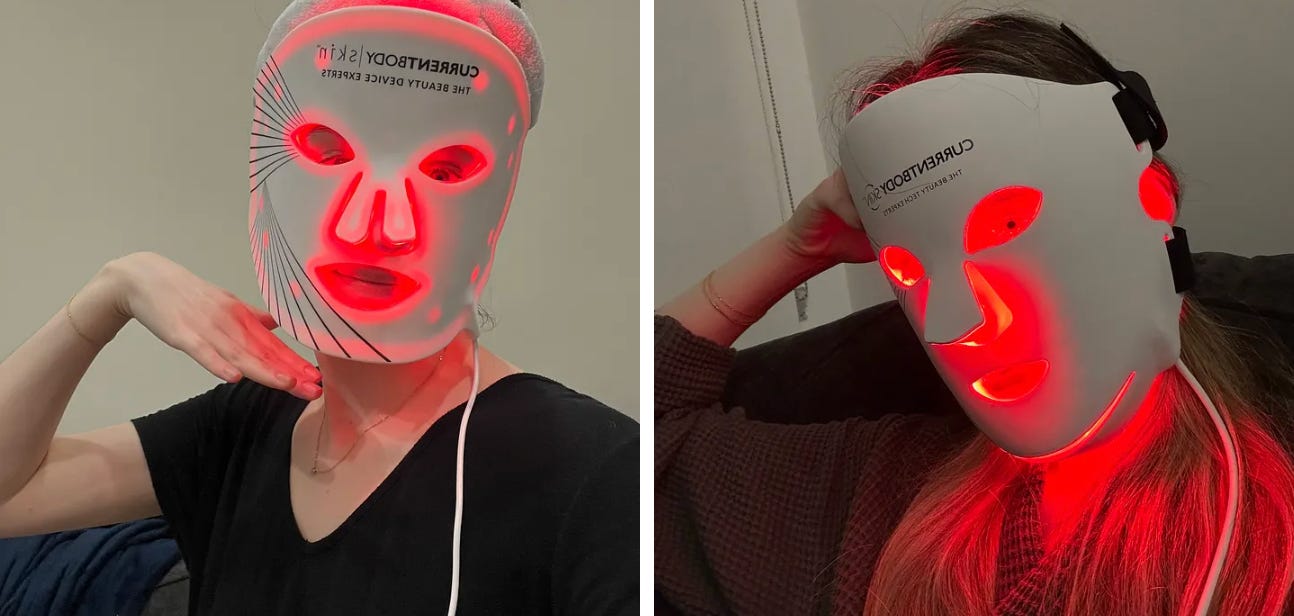
Usually when I mention CurrentBody, I’m talking about their LED products, of which I am an extremely loyal user. Years of consistent use have left my skin noticeably more resilient, youthful and even. It’s a big part of managing my acne (reducing inflammation & speeding up healing) and if my forehead at 33 is any indication, it’s excelling on the anti-aging front.
I’ve continued to write and partner with the brand because I truly think they’re the best in the business. That business, of course, being beauty technology. In the past, I’ve dove into the science of LED, compiled a comprehensive FAQ, advised on how to use the mask in a routine and campaigned for it as your next gift idea, to name a few, but one area I haven’t focused much on is the brand itself, and how, exactly, they became the best.
I’ve been wanting to interview the founder and CEO, Laurence Newman, for a while, and finally got the chance a few weeks ago when he was in New York. I showed up to coffee with questions prepared—which turned into two hours of chatting, covering everything I’d planned to ask and then some, and also confirmed everything I already believed about how deliberately this company is run.
Since founding the company in 2009, Laurence has grown CurrentBody from a beauty device distributor into The Beauty Tech Group—building out their own device lineup while strategically acquiring others—and as of this year, going public on the London Stock Exchange. In this interview, we get into what it actually takes to build (and buy) a beauty tech portfolio, how he thinks about acquisitions, his commitment to research and a liittttle sneak peek at what’s coming next.

Today’s post is sponsored by CurrentBody! I’m forever grateful to the brands that sponsor the newsletter and make it possible. This interview has been transcribed and edited for length and clarity.
As part of this series, you also get the opportunity to ask your own questions! Ask Laurence anything in the comments and he’ll pop in over the next few days to answer.
Don’t forget, you can use code JOLIECB for 10% off sitewide.
Can you share a bit about your current role and professional background? Introduce us to Laurence!
I’m the founder and CEO of The Beauty Tech Group, which owns CurrentBody, ZIIP and Tria Laser. The business is about 260 people, with a headquarters just outside Manchester, offices in Shanghai and LA and 7 warehouses globally, supporting roughly 80 countries.
My background is in aesthetic devices, specifically professional equipment. About 25 years ago, I started out selling devices directly to clinics and salons, which is how I learned about the different technologies—how they work, why they work and why sometimes they don’t. I also owned a clinic myself for a while, so I learned about patient tolerance, expectations, different skin and hair types and why one device doesn’t work for everyone.
For a stretch of my career I was working on cruise ships, selling to the on-board spas. One treatment I was selling got great results on board, but I’d lose the client the second they got off the ship. That problem—how do you let someone carry on treatment once they’re home?—is basically the idea CurrentBody was built on.

Please tell me more about this cruise ship origin story.
On board, I’d do what I called a trunk show: stand in front of guests and talk about how a treatment might help them while they traveled. The specific treatment I was selling was called electrolipolysis, which used a weak electrical current to help break down fat cells and support lymphatic drainage. As I mentioned, great results, but then they’d leave the ship and that was it.
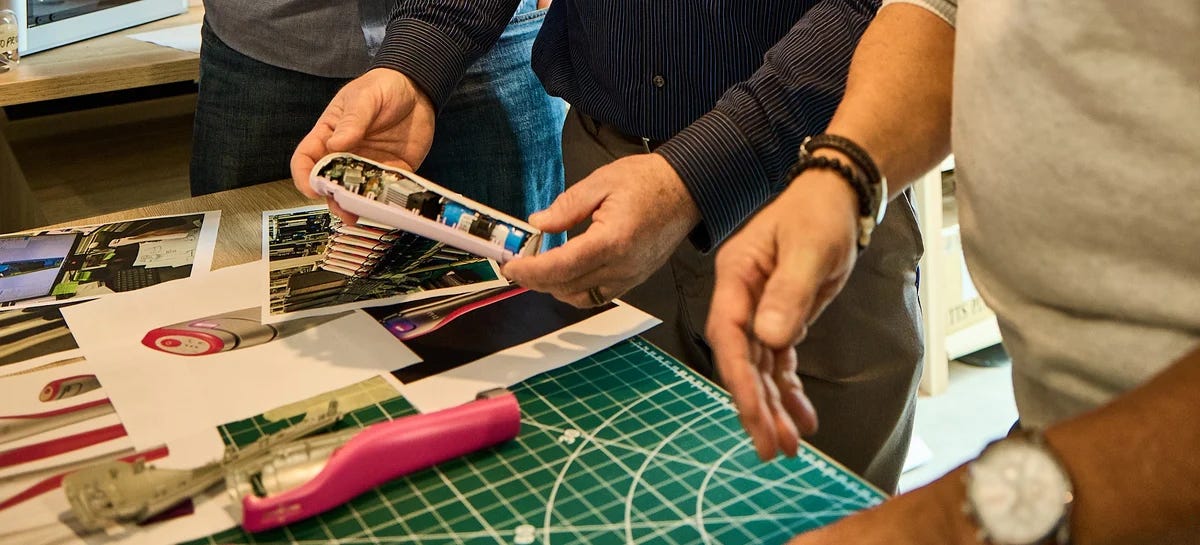
At a trade show in Germany, I met a company called Compex, who made electrical muscle stimulation devices, mostly for sports therapy. I asked if they could replicate the microcurrent from the treatment I’d been selling on ships and shrink it into something people could take home. They scaled down one of their products into a little handheld device, which I started selling on ships for $500. After they’d received the professional treatment on-board, we’d ask: would you like to keep having this at home? That was my first real signal that there was an interest in being able to do treatments at home, not just receive them in professional settings. Then it all sort of clicked—if this microcurrent technology could be miniaturized, at some point, every key technology sitting in a clinic should be able to be miniaturized too, those being LED, radiofrequency, laser and microcurrent.
When you launched CurrentBody in 2009 was “beauty tech” even a thing?
The category itself barely existed. We used to be called CurrentBody, The Beauty Device Experts, but the word “device” just didn’t really translate well to beauty nor accurately capture the extent of what we were doing, so we pivoted to “technology” and are now the biggest beauty tech company in the world. Of course, we literally sell devices, but we’ve stayed in our lane and stayed focused on becoming beauty technology specialists.


Was the original vision to create your own device in each of those technology pillars or to acquire existing companies?
My original plan was to start by going around and find existing technologies in each of those 4 buckets, which I did. There wasn’t much around at first, but things were starting to evolve, and you’ll probably recognize or even use some of them: ZIIP, Tria, Tripollar, NuFACE, Foreo, Clarisonic. Founder stories often get embellished, but I really did always have the plan to eventually have one CurrentBody-owned device in each bucket. But I set up CurrentBody in 2009 as a platform to sell all of those products, a distributor really, which is what we did through to about 2018.
I spent those 10 years building up the brands I was selling and learning a ton along the way—how to sell and distribute, how to talk to customers, how to innovate in the space and crucially, what customers want: simplicity, quick results and long-term benefits. Our first foray into our own product was LED, which started to do reasonably well, and made me confident that was the right way forward, so we did the same thing and developed our own radiofrequency.
Then when there was an opportunity to make an acquisition of the other technologies, which I had become very familiar with over the 10 years of selling the brands, I went for it. For microcurrent, in my head, the best-in-class was ZIIP, but it hadn’t scaled yet. Tria, for lasers, also made a lot of sense because the technology is probably the hardest to go and make (about 7 years with all the regulations, safety and efficacy testing that go alongside it). So eventually by owning Tria and ZIIP, and CurrentBody for LED and radiofrequency, we have the full train set and that’s where we are. A multi-territory, multi-brand company, listed on the London Stock Exchange, valued at close to £400 million.
You've said some investors—mostly middle-aged men—didn't take beauty tech seriously and I’m curious what that pushback/doubt sounded like in a pitch meeting.
Honestly they’re just not educated in the space, so you enter a meeting starting at 30-love down, unless their wife, girlfriend or daughter already uses one. A lot of it comes down to getting rid of the “fad” label—LED has been around since the 1960s and has been widely used in clinics for decades, but to them it’s a recent thing. They think wearing a mask can look a bit silly, or they see someone on Instagram dancing or scaring someone while wearing it…that’s their entry point. They’re not in this world everyday, having conversations about skin and hearing about the desire to improve it. It probably takes about 3 to 4 meetings for investors to really get the full picture.
What kinds of questions are they asking in those meetings?
It always starts with the “does it even work?” questions, but the biggest thing to get their head around is the longevity of the market. They’re thinking “what happens when everyone has one?” And I have to explain that everyone doesn’t have one. I sometimes use an old example of Clarisonic, a facial cleansing brush, very easy to concept to get in theory. L’Oreal sold 10 million units, but their own research found that only 2 out of 10 people had heard of it. 10 million units was still only a fraction of the market! Our research shows that we’re at roughly 3% penetration, so even growing 10% a year, you’re talking close to a decade before real market awareness sets in.
Everything is about trying to educate. It’s very difficult, but you have to keep educating and imagine 10 or 15 years ago, it was even harder. You go into mass distribution thinking there’s awareness out there that there isn’t, start eroding your price and then your brand is in trouble. That’s happened to a lot of device companies over the years, whereas we’ve always understood awareness is low, so education has to be high.
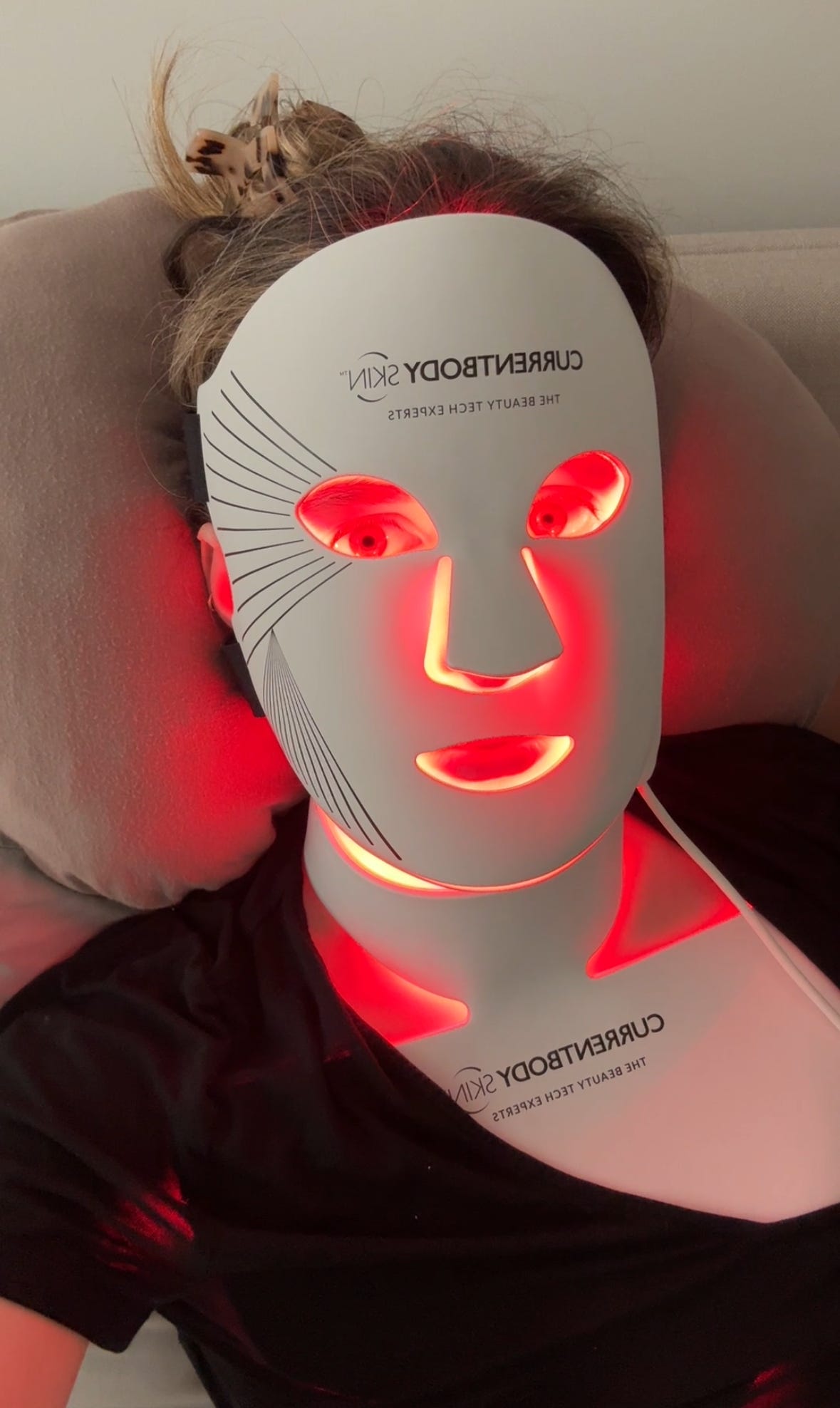
That’s something I have to remind myself of a lot, with skincare education in general, but especially LED. Even though I feel like I’m constantly repeating myself and answering the same questions, that’s not the reality. There’s so many new people to reach and they all need to be educated. So once they understand the untapped market, then you have to explain why CurrentBody is best equipped to capture it and why not all masks are created equally?
Exactly. I think the misconception is that it’s saturated in perception, not in reality. It’s a bit like vitamin C—you can find thousands of products, but it’s mostly a perception of saturation rather than genuine competition.
There are really only a couple of serious players in this space, because what we’re doing is very time consuming and expensive. But even among them, we stand out because our focus is different compared to a skincare company that makes a device. We were never built for the same reason. Skincare isn’t our core business, it’s device R&D. We’re committed to being the best in the beauty tech category and that is literally all we do. We know it’s brand recognition that gets people over the line to purchase: 70% of people who buy our product are specifically looking for “CurrentBody LED Mask” not just generic “LED mask.”
With LED specifically, the biggest misconception is that they’re easy to make. People see one on Instagram from some random brand and think it’s easy, but it’s probably the hardest product to make at scale. Making hundreds of thousands means you’re literally making millions of individual LEDs. It takes 2 years to make a new LED product—6 months of new product development to understand what we’re trying to do; 6 months of prototyping at least; 6 months to manufacture at scale and then 6 months of regulation and mass production.


So in addition to owning manufacturing and production, you’re advancing the technology through a dedicated research arm?
Yes. Fundamentally, we want products that work and are safe. Everything we do, any new upgrade, is rooted in the actual science. We want to understand what’s happening to the skin at a deeper level in order to understand what we need to build into the next product and move the industry forward. A double-blind clinical study costs £250,000-600,000, so who’s actually going to fund that? We are, because we’re building for the next five to ten years and our commitment is to investing in the technology and research.
We work with the University of Manchester, which is where we’re based, and there’s a nice synergy working with the local university. We also work with Eurofins, SGS, Intertek [Ed. note: 3 of the world’s biggest independent testing, inspection and certification companies] and we’re now even involved in developing new industry-wide testing standards. We are funding this research, but not just for ourselves. It’s about understanding what needs to go into the next generation of products, and as a listed company now, there’s an expectation that we lead on research, not just products. We’re asking questions like “how do we know it will work on darker skin tones?” and “what is the demonstrated effect on mature skin?” and funding those studies.
One novel study we did with the University of Manchester involved taking live skin biopsies from 65 volunteers to understand the effect of our wavelengths at depth. It’s the first time LED research has been done this way.
By the time you release a product, you’ve already been working on the next iteration. This is related to something I’m asked about constantly: what do you say when a customer asks whether they actually need the newest version of a device versus their current older one that’s still doing the job?
Think of it like an iPhone, you’re not always getting the newest version if yours is still working. Usually when you upgrade, you’ll be skipping some generations. That’s just how technology works. Loads of people still have the Series 1—it’s still a robust mask that works really well, with 2 of the 3 clinically proven wavelengths that are in the Series 2. With the Series 2, we’ve nailed the wavelengths and the shape, so our next mask isn’t going to change those features. I’m not telling my own friends and family with the Series 2 that they need to upgrade because they have a great product and we don’t expect everyone to upgrade as soon as a new mask comes out. We’re not chasing an upgrade cycle, we’re going after the huge market of people who have never bought any device before. But because we can track it, we also do know that a high percentage of people who bought a device years ago have since bought another LED device or upgraded mask.
Obviously we share a passion for educating people about LED, so let me see if I can help. Is there something with LED that you find particularly challenging to explain?
Power. Everyone assumes that “more power” or a “50x stronger mask” means better or faster results. But it’s not about having the most power, it’s about delivering the optimal dose of it, which is something we’re focusing on educating about with our next products. (Wink wink).
Yes! That’s exactly how I explain sunscreen. It’s a drug, and like with all drugs, there are doses. You need to use the proper amount of sunscreen—the right dose—to get the stated protection on the bottle. Just like with any other medication, if you use half the amount, you’re not getting the full benefit. I guess sunscreen is the sole exception to this rule, but generally it also goes the other way, with overdosing: taking more can actually be counterproductive, diminishing returns or having a negative effect.
Exactly. With dose, people can start to understand the medicine analogy: you don’t take 5 acetaminophen when you have a headache, you take 2. So in our case, we’ve determined through our research what the optimal dose is, and built our products around that clinical evidence. [Ed. note: To read my best attempt at explaining dose/LED, start here, then scroll to here. And for more on the sunscreen dose, read here.]

Final questions I ask everyone. Favorite socks, favorite sandwich, favorite tv show, favorite toothpaste?
Favorite socks: my kids give me a hard time because they say I shouldn’t be wearing long socks at 52. My daughter is 17 and tells me I’m not cool enough, but I wear them anyway, no specific brand.
Favorite sandwich: In New York, Katz’s. Corned beef on rye, mustard, pickles on the side.
Favorite tv show: I have a hard time sitting still, so I barely watch TV or movies, but the last thing I properly binged was Below Deck. I like boats and used to work on cruise ships, so that tracks. Otherwise, I watch a ton of sports. Manchester City is my team, but I’ll watch anything.
Favorite toothpaste: Honestly, I don’t really have one, but what I am obsessed with is interdental sticks, the little picks. I keep them everywhere.
Thank you for stopping by, Laurence! Have any questions of your own? Ask away in the comments!


You can get 10% off all brands with the following codes:
CurrentBody: JOLIECB
ZIIP: ZIIPJOLIE
Tria: JOLIE
(and no, I haven’t written about Tria…yet! But trying out the laser hair removal device is a fall/winter project.)
xx,
Jolie
I was so excited to finally get a ZIIP in November after seeing so many people (including Jolie) rave about it for years, but when it suddenly broke in less than 5 months, I was pretty shocked by how awful Current Body's customer service was. Unfortunately, it seems like my experience was fairly common and though I was eventually able to get a replacement after a bunch of back and forth, it was such a bad experience that I will not be purchasing anything else under Current Body unless they do a big customer service overhaul.
hi! just read this interview about the cutting edge devices.
I have nearly constant cystic acne, meaning, its a rare day if I don’t have at least one painful zit. most of my acne is painful and usually deep, often doesn’t come to the surface for a few days to a few weeks, or never does. I already use the current body red light mask 2. what secondary device and related products would you recommend for someone who just can’t seem to get on top of their acne? (ziip halo or dot, anti acne red/blue light pen, etc)