

Buffering vs. Bare Skin
there are very few rules in skincare, but this one is good to know
Hello!
Thank you all so much for the wonderful feedback on last week’s Year of Consistency final update. It literally makes me giddy to hear how much you were able to learn and incorporate into your own routines.

For today’s post, I opened up the eponymous Hotline (Skin)! The question I’m answering reminded me of one from last year about product layering in general, which you might want to review.
Have a question you want answered? Submit it below and you might see it answered in a future issue!
Now it is time to put on your chemistry hats!

Are there any skincare ingredients that don’t work (or don’t work well) unless they are the very first item you apply after washing your face? I’m a big fan of buffering but I also wonder if some actives get too diluted (or something like that) if they are layered on top of something else. Thanks!
You are welcome and I’m sorry because we must get into a concept that perhaps— like I believed to be the case with long division or trigonometry—you thought would have no practical application in your life: pH.
pH stands for “potential hydrogen.” It’s a scale from 0–14 that measures how acidic or alkaline a substance is. A pH of 7 is neutral. Anything below 7 is acidic, and anything above 7 is alkaline (or basic). Think of pH like temperature—a characteristic that helps describe how something behaves and interacts with its environment. (See? You can get the gist without me even explaining what on earth “potential hydrogen” means!)
When it comes to skin, pH plays a crucial role in maintaining a healthy microbiome and a strong barrier. The skin’s natural pH is slightly acidic, around 5.5. To an extent, our skin has the ability to self-regulate pH, but when that balance shifts too far in either direction, it can affect how the skin functions, leading to irritation, dryness, sensitivity, breakouts, flaking, and other changes in texture/behavior. But sometimes a little shift in pH is necessary…
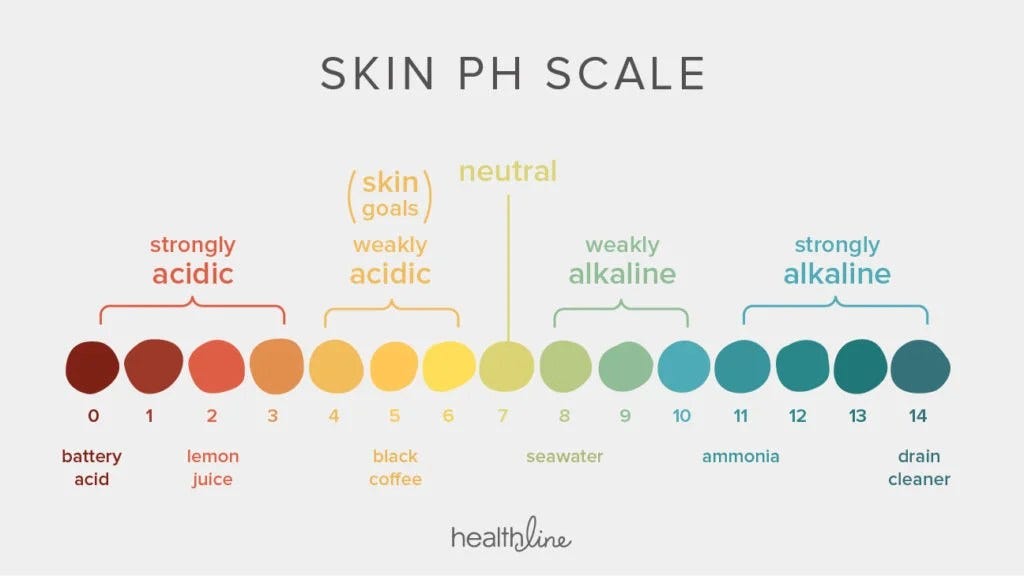
Just like skin, ingredients also have an optimal pH range where they work best. Exfoliating acids (AHAs/BHAs, such as glycolic, lactic, mandelic, and salicylic acid) need a lower pH (typically around 3–4) to properly exfoliate and penetrate the skin. Remember pH is a characteristic: they are exfoliating acids because of their acidity. When properly applied, they temporarily lower the skin’s surface pH, but healthy skin is designed to rebalance itself + well-formulated products have ingredients to buffer/neutralize or otherwise control their intensity.
Pure vitamin C, or L-ascorbic acid (L-AA), also has an optimal pH of 3-3.5 in order to properly penetrate the skin. Because of L-AAs low pH, it can be quite irritating for some people. Vitamin C derivatives have higher/less sensitive pH values.
SO! To answer your question: because skin’s pH is around 5.5 and exfoliating acids and L-AA have a lower pH, it is important to apply these products on clean, bare skin after cleansing. Otherwise, your other products may slightly raise the pH of your skin, thereby inhibiting the exfoliating action/penetration of your acids/L-AA.
(Btw, pH is one of the key differences between at-home exfoliants and professional peels. Professional acids are formulated at a much lower pH, which increases their exfoliating power. However, we’re trained to apply them in a controlled setting, with proper timing/layering/neutralization to ensure safety and optimal results.)

How long do I have to wait after applying exfoliating acids/L-AA?
You’ll see different answers depending on where you look. The main concern is whether the next product you apply might raise the pH of your skin before the exfoliant/vit c has a chance to work. For at-home products, this isn’t usually something to worry much about. If you have the time, I’d recommend waiting 1-3 minutes in between, just enough for it to absorb or dry slightly, then continue with the rest of your routine. This gives the low-pH product a bit of “breathing room” without overcomplicating things. (An exception is if the product instruction says to wait longer, then I’d listen.)
What if my moisturizer (or another product that isn’t a “direct acid”) contains exfoliating acids?
Don’t panic & trust the chemists! The pH guidance here primarily applies to direct exfoliating acids aka formulas specifically meant to resurface/exfoliate the skin. Formulators have multiple ways to design delivery systems so a product can be used at different stages of your routine while still functioning as intended. The presence of an acid on an ingredient list doesn’t automatically mean it’s there to exfoliate. In fact, acids can serve other purposes, depending on the concentration used (ex: lactic acid at certain concentrations acts as a humectant and helps hydrate the skin!)
So are hyaluronic acid and azelaic acid not exfoliating acids?
Correct! The word acid in skincare doesn’t automatically mean that it is exfoliating or does something with the pH of your skin in order to work. Acid is just a type of chemical structure and that’s as far as I’m getting into this because you will only get more confused. This whole discussion of pH only matters for AHAs/BHAs/PHAs (alpha hydroxy acids, beta hydroxy acids and polyhydroxy acids) and pure vitamin C.
How does all of this relate to retinoids?
Retinoids (and basically all products) have optimal pH for stability, but not for skin activation. They don’t really alter the pH of your skin nor need a low pH to properly function. So it’s totally okay to buffer retinoids.
Here’s what to consider with buffering: the closer something is to your bare skin, the more potent it is because there is nothing blocking its path to your skin. When you apply moisturizer before and/or after your retinoid, it creates a slight buffer that slows penetration and reduces irritation. This doesn’t block the retinoid or reduce its long-term efficacy, but it does make retinoids more easy to use consistently, and that’s really the key here. Retinoids take time to work, but they can be irritating, which often leads people to stop using them or apply them inconsistently. But using them inconsistently will never give your skin enough of the ingredient to produce results. So, if buffering is what allows you to tolerate regular retinoid use, then in practice, buffering is actually increasing the effectiveness ;)
In terms of waiting time, it’s again because of irritation risk, not efficacy. Particularly with prescription retinoids, occluding the retinoid too quickly by applying moisturizer on top can cause sensitivity in some people, so you might want to wait 10-15 minutes, at least to start. If your skin tolerates it fine, then just give it a minute and get going.
Hats off to you! Have a great week!
xx,
Jolie
Office Hours Reminder
Join us for Office Hours on Sunday! This exclusive weekly opportunity is available to paying subscribers.
Every Sunday around 5pm EST, I’ll begin a new thread for the week in Substack Chat, where you can ask me anything. Every Monday from 8-9pm EST, I’ll be in that chat live, answering questions for the hour. That way, if you can’t make it, you can submit any time after 5pm Sunday and still get an answer. If you can make it live, join in! You can ask questions in real time and (hopefully) interact with others in class ;)


need a breakdown on azelaic acid!